

When the dot-com bubble burst in 2000, it didn’t just erase trillions in market value. It exposed something more fundamental — how the first generation of internet companies thought about customers, competition, and growth. Among the most symbolic casualties was theGlobe. com, a social networking pioneer that promised to connect the world long before Facebook, Twitter, or TikTok ever existed.
In my work for the book, Ideas Don’t Die. Companies Do, I studied why companies fail not from a lack of ideas, but from a failure to stay at the edges of what’s possible. That’s the central argument in my book. And few cases illustrate it better than theGlobe. com — because its collapse wasn’t really about timing or irrational exuberance. It was about a company that retreated to the center when the moment demanded it live on the edges.
The Four Edges Framework describes the strategic tensions that separate companies that scale from those that stagnate. Each edge isn’t a choice between two opposing forces — it’s a productive friction that must be managed, continuously, as markets shift beneath your feet. theGlobe. com failed to navigate any of them. Snap, Pinterest, and Nextdoor — built a generation later — learned to thrive precisely because they did.
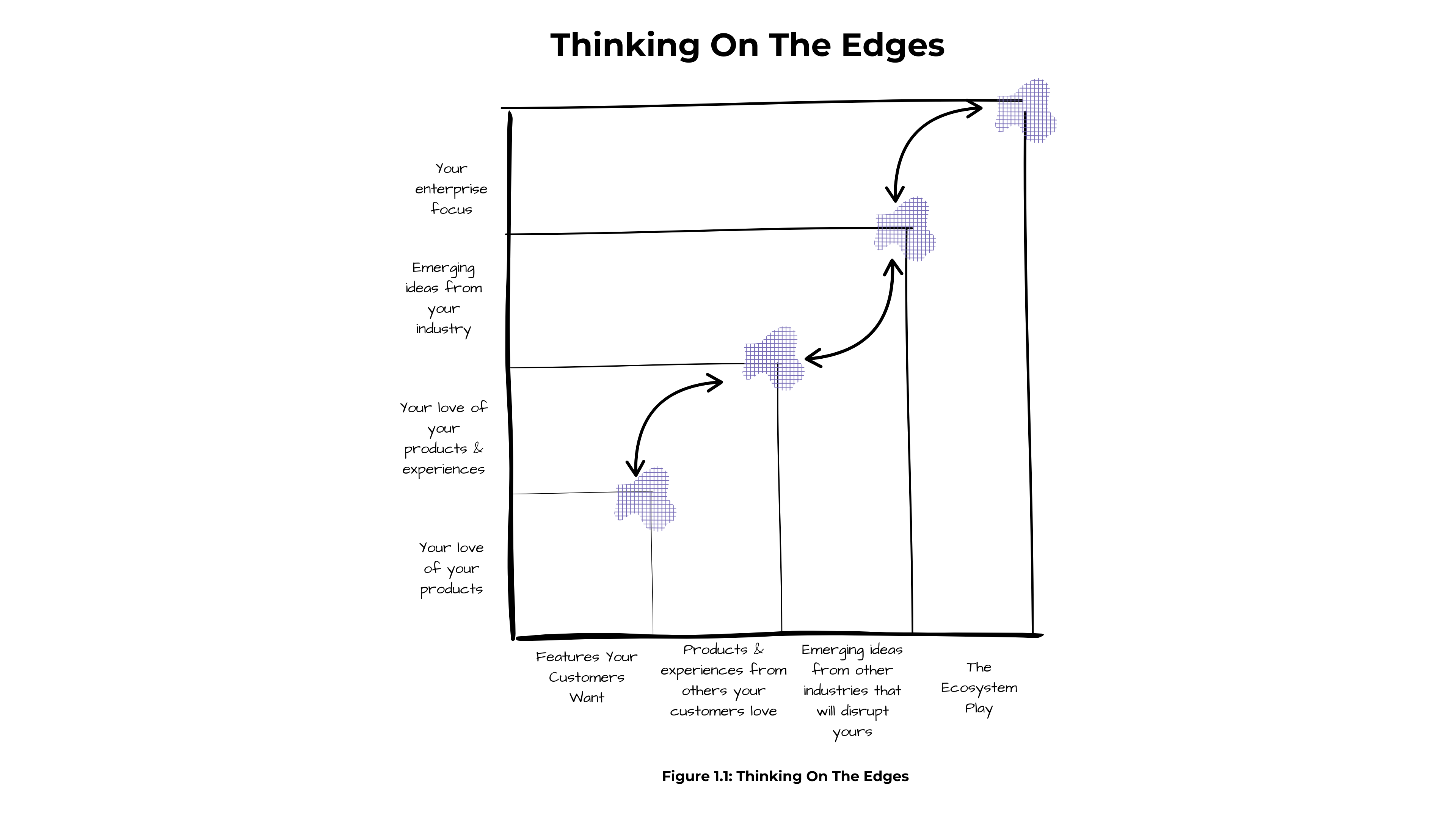
Edge One: What You Love vs. What Customers Want
The first edge is about obsession — the gap between a company’s love for its own product and what customers actually value. I put it simply in the book: you have to love your customers’ lives more than you love your own product.
theGlobe. com never made that trade. It was dazzling for 1998 — message boards, profiles, virtual “rooms” — but disconnected from a clear, felt need. Users came to explore; few stayed to belong. Monetization chased banner ads and page views instead of the kind of sustained emotional value that actually earns daily habits.
The contrast with the modern platforms is stark. Snap stripped communication down to a raw, ephemeral camera interface — not posts, but moments. Pinterest reimagined search as inspiration, a visual bookmarking tool for the future self. Nextdoor went after a deeply local, high-trust need that no platform had touched: connecting neighborhoods, not networks. Each one began with a singular customer job, and built from there.
theGlobe. com shipped what it could build. These companies refined what people would return to every day. That difference — in philosophy more than in execution — is what created lasting user habits and resilient revenue models.
Edge Two: Your Product Experience vs. Customers’ Love of Other Experiences
The second edge is one most companies get wrong because it requires looking away from your own product entirely. Customers don’t benchmark within industries. They compare experiences across every interaction they have — and their expectations are shaped accordingly.
theGlobe. com was trapped in the mindset of the late-1990s web portal. It wasn’t learning from what was happening elsewhere — the trust and verification models emerging in e-commerce, the personalization logic of early search, the simplicity that mobile messaging would soon demand. Its reference point was itself.
The next generation of platforms did something different: they borrowed deliberately. Snap drew from the immediacy of smartphone cameras and the native gestures of mobile operating systems. Pinterest combined retail merchandising with search discovery — window shopping as an algorithmic art form. Nextdoor adopted the civic-platform conventions of real-name policies and local verification, importing trust structures from public institutions rather than from social networks.
I call this “seeing across the edges of experience” — the discipline of translating internal excellence into external differentiation. It’s how companies stay empathetic in ecosystems where user expectations move faster than any technology roadmap.
Edge Three: Ideas from Your Industry vs. Ideas from Other Industries
Through the years, I have come to believe deeply that the most important innovations rarely come from inside an industry. They come from leaders who have the skill — and the humility — to borrow intelligence from elsewhere and apply it somewhere new. I call it moving intelligence, and it’s one of the rarest competencies I see in leadership teams.
theGlobe. com’s innovation lens was narrow. It defined itself as a “community portal” and competed accordingly — chat rooms, web rings, user pages, feature against feature with other portals. It never asked what was being built in adjacent spaces: data analytics, recommendation engines, mobile interfaces, trust architecture. It didn’t know what it didn’t know.
Snap, Pinterest, and Nextdoor thought differently. Snap borrowed storytelling formats from television and film and adapted them to the constraints of a mobile screen. Pinterest drew on machine learning from ad-tech and e-commerce to sharpen discovery. Nextdoor fused principles from civic-tech, public safety, and community organizing into its network design — giving it a texture that no pure social platform had.
In the book, I describe this as “building an unnatural capability” — the intentional development of competencies that feel foreign to your current identity but are essential to your future relevance. theGlobe. com was static because it only learned from its peers. The other platforms were adaptive because they learned from everyone else.
Edge Four: Enterprise Focus vs. Ecosystem Thinking
The fourth edge is about scale — specifically, whether you measure success by what you capture, or by what you enable others to create.
theGlobe. com’s model was entirely insular. It lived on advertising revenue and traffic spikes. There were no APIs, no creator incentives, no infrastructure for partners to build on top of. When the bubble burst, there was nothing underneath the platform to hold it up. It collapsed under its own isolation.
The modern platforms inverted that logic. Snap grew a creator ecosystem that feeds a global advertising and AR network. Pinterest connected brands, retailers, and creators in a shared economy of discovery — one that has outlasted every prediction of its irrelevance. Nextdoor opened its platform to local businesses, realtors, and public agencies, embedding itself into the civic infrastructure of neighborhoods in ways that no other network could replicate.
This is what I mean by ecosystem thinking: success measured not only by what the company gains, but by what it enables others to create. The difference between theGlobe. com and what came after it isn’t just product design — it’s the difference between building a website and building a platform. Between a passing trend and a durable economy.
Beyond the Edges: Unnatural Capabilities
There’s a thread running through all four edges, and it’s one I return to repeatedly in Ideas Don’t Die. Companies Do.: the winners built capabilities that felt unnatural at first.
Snap became an advertising and augmented reality company. Pinterest evolved into a commerce and search engine. Nextdoor became part social network, part civic utility. Each of them invested, early and seriously, in data science, trust operations, and privacy infrastructure — areas far removed from their original “social” identities.
The Real Lesson: Living on the Edges, Not in the Center
The deeper insight from this comparison isn’t about platforms or social media at all. It’s about organizational behavior under pressure.
Companies thrive not by choosing one side of an edge, but by continuously oscillating between them — loving a product while evolving it relentlessly, learning from their industry while reaching beyond it, serving their enterprise while expanding their ecosystem. That oscillation requires discomfort. It requires leaders willing to look foolish in the short run for the sake of staying relevant in the long run.
theGlobe. com couldn’t sustain that tension. It settled into the center — stable, familiar, and ultimately invisible. Snap, Pinterest, and Nextdoor learned to live at the edges, where growth feels risky but renewal remains possible.
The contrast between them captures the evolution of the internet itself. The early web connected people through pages. The modern web connects people through purpose.
And the distance between those two things — the gap between what theGlobe. com was and what its successors became — is precisely the distance between companies that vanish and companies that endure.
Invite Hari To Speak