
The book exploring six powerful intersections between 12 disciplines shaping the future of our world. Hari Abburi co-authored a chapter, Thinking Like An AI Native to enable leaders to reimagine their organizations if they were born in the future where AI was a natural native layer.
Chapter 3: Thinking Like An AI Native | Co-Authored by Hari Abburi & Dr. Efi PYLARINOU
The chapter opens by drawing a hard distinction that most executives conflate: a business using AI is not an AI-native business, just as a traditional firm deploying digital tools is not a digital native. The authors — Hari Abburi and Efi Pylarinou — argue that AI-nativity is an entirely new business archetype, the fourth in a progression from Traditional → Digital Native → Blockchain Native → AI Native, each with its own structural logic and competitive moat.
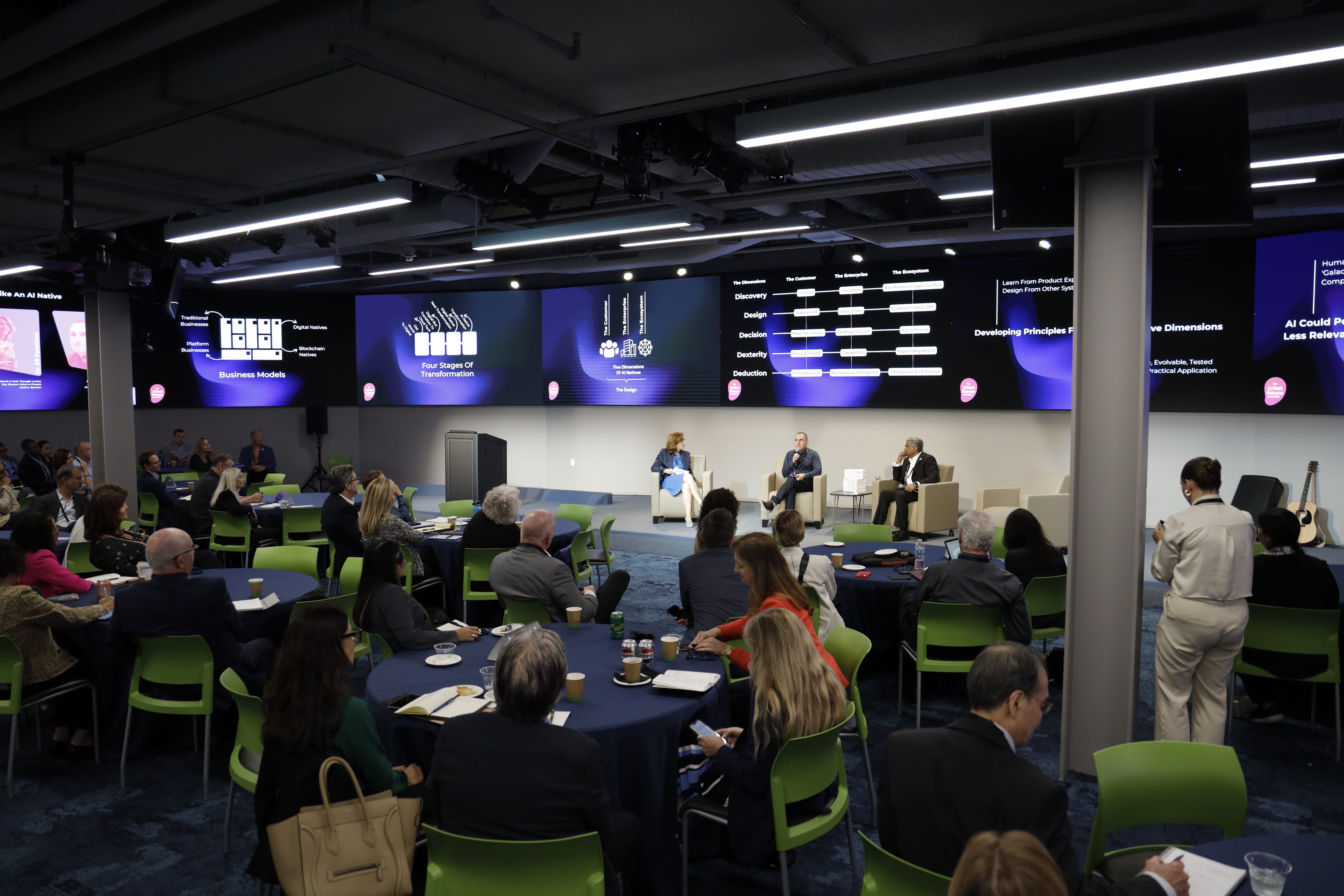
The central diagnosis is that digital natives, despite their sophistication, remain prisoners of linear thinking. They plug AI into discrete modules — a fraud-detection model here, a recommendation engine there — and let humans interpret the context. This works up to a point, but it cannot cope with the cascading, non-linear interdependencies that define modern business complexity. Bloomberg’s AI analytics tools are held up as an instructive case: powerful in isolation, yet unable to contextualise one insight against another in real time. That limitation, the authors argue, is not a product gap but an architectural one.
The unlock is foundation models. Unlike task-specific AI, foundation models are trained on vast unlabelled datasets and can be fine-tuned across an entire value chain — customer, enterprise, and ecosystem simultaneously. They enable what the authors call contextual feedback loops at scale: the capacity to process complexity the way a galaxy processes physics, continuously and in every direction at once. The galaxy metaphor is deliberate. AI-native companies are not point solutions; they are intelligent systems where every node — every customer interaction, every strategic decision, every ecosystem signal — informs every other node, 24 hours a day.
Thinking Like An AI Native Framework
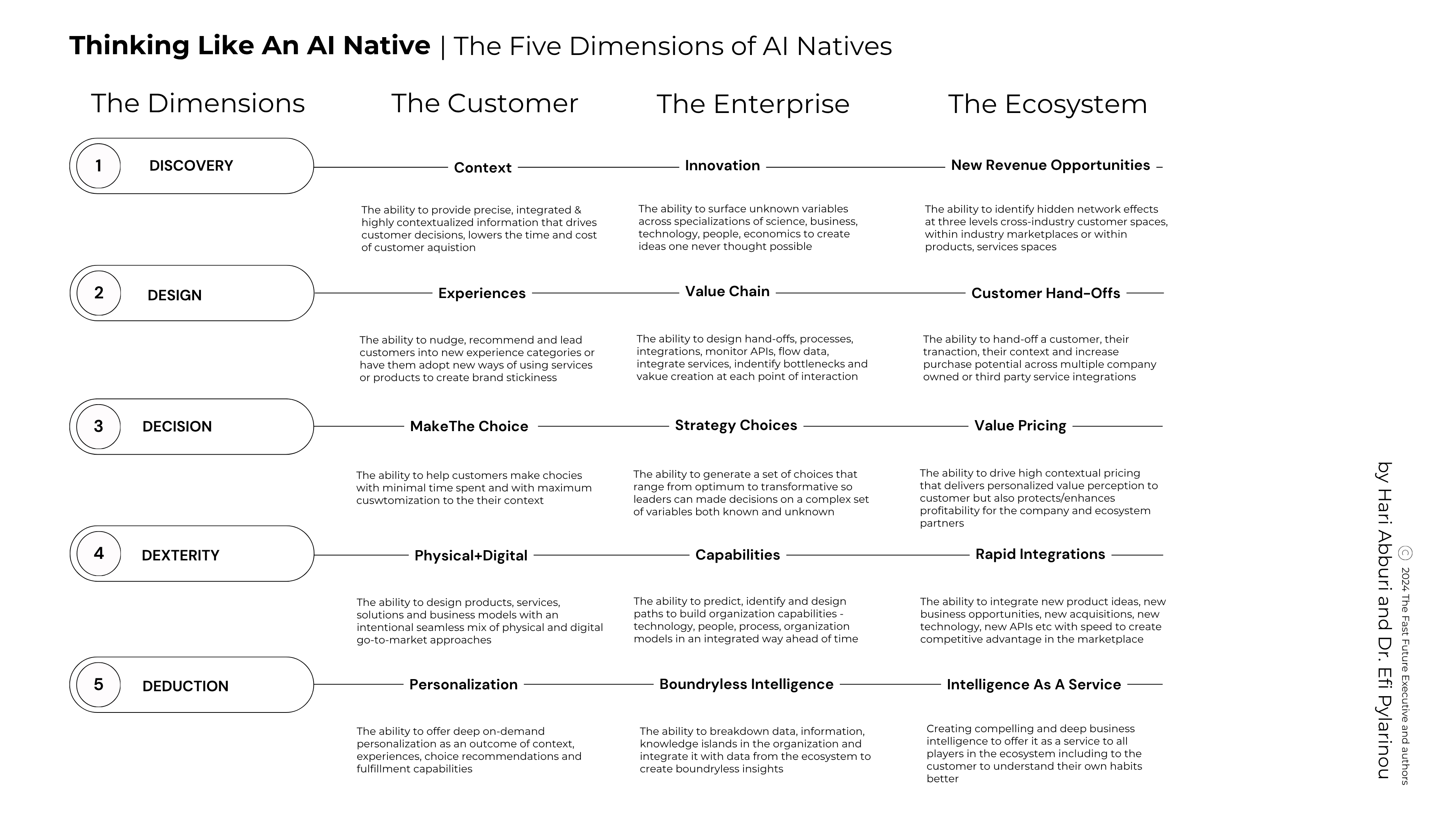
To operationalize this, the authors introduce a five-dimensional framework — the 5Ds — that maps how AI-nativity manifests across the three business levels:
Discovery is the ability to surface context, intent, and opportunity that humans or conventional analytics would miss — hyper-personalized customer journeys, breakthrough innovation leads, hidden ecosystem network effects.
Design is the capacity to architect products, services, and business models that blend physical and digital seamlessly — Apple’s hardware-software integration is cited as a near-approximation, but a true AI-native design goes further, continuously adapting in response to contextual signals.
Decision is where AI-native companies most dramatically outpace digital natives. Rather than a handful of leaders combining experience and dashboards, AI-native enterprises make strategic choices using dynamic, non-linear intelligence drawn from the entire galaxy of the business.
Dexterity is the operational fluency to serve customers across physical and digital touchpoints without trade-offs — not segmented by demographic proxy, but contextualised to the individual in real time.
Deduction is the intelligence layer that compounds everything else: predictive personalisation, ecosystem-wide business intelligence, and the ability to anticipate organisational capability needs before they become bottlenecks.
The chapter closes with a call to action. The first generation of AI-native businesses has not yet been born — but the leaders of today’s digital-native and traditional firms who begin thinking like AI natives now will be the ones who architect that future, rather than be disrupted by it.
Watch the authors explain the framework at The Fast Future Blur Summit 2024
Read More on The Fast Future Blur


